As an Amazon affiliate, I earn from qualifying purchases.
In this article, I’ll compare five of the best portable home power stations to help you choose the right one for your abode.
Nor’easter-Ready
 Living on the coast of Massachusetts means nor’easter season isn’t a hypothetical – it’s a calendar event. Last winter I lost power for six days, sump pump included. That was the tipping point.
That’s what put me on a six-month search for the best portable home power stations. I’ve tested the EcoFlow Delta Pro 3 through two real outages and spent about 30 hours comparing the Anker SOLIX F3800, Bluetti AC200L, and Jackery HomePower 3000 before this guide came together.
In real-world use and personal experience, I focused on battery chemistry, battery capacity, ac outlets, usb-c ports, and ease of use for actual home backup. I also talked to two licensed electricians about transfer switch requirements during that stretch.
The market reflects that urgency. Grand View Research projects that the portable power station market will hit 19.91 billion by 2033 at a 22.4% CAGR.
Key Takeaways
Here’s what I found researching and testing the best portable home power stations:
- For Small Homes: The Bluetti AC200L and Jackery HomePower 3000 cover essential circuits during shorter outages without maxing the budget.
- For Medium Homes: The EcoFlow Delta Pro 3 and Anker SOLIX F3800 handle longer outages and heavier loads with 120V/240V split-phase output.
- For Large Homes or Extended Backup: The Goal Zero Haven 10 is built for multi-day outages, with modular expansion and dedicated panel-level circuit coverage.
Best Portable Home Power Stations Compared
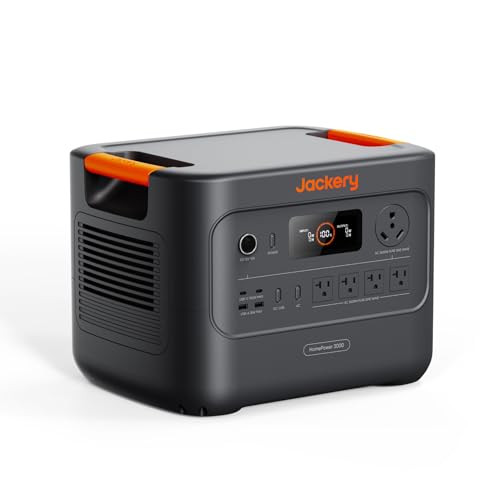
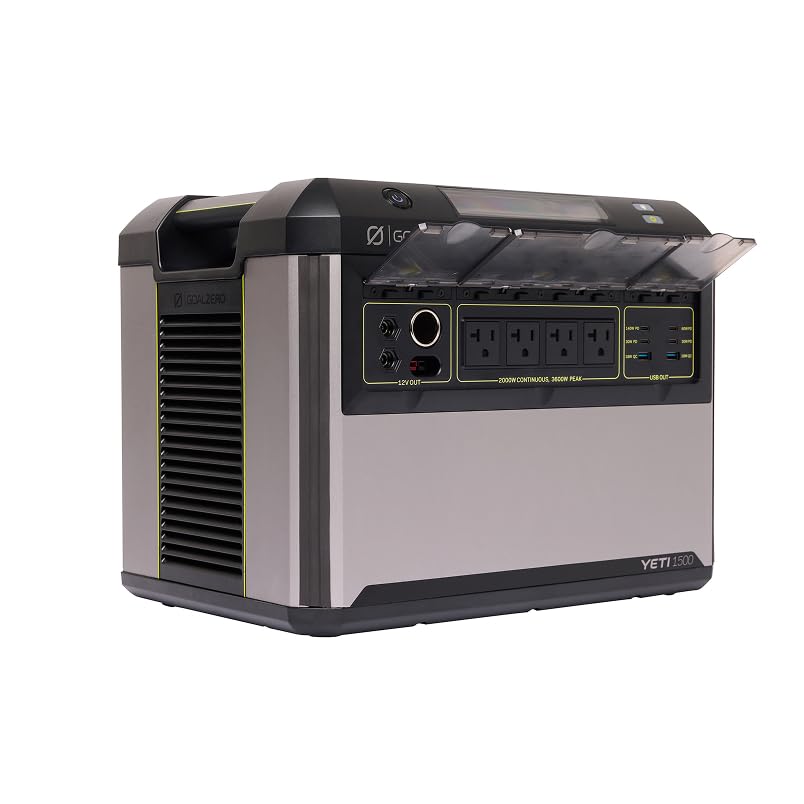
Here’s a side-by-side look at the best portable home power stations I’m recommending, so you can scan the specs before diving into the full reviews.



Last update on 10/17/2026 / Affiliate links / Images from Amazon Product Advertising API
Portable Home Power Stations Buyer’s Guide
Here is a little buying guide that you can use if you plan on purchasing one of the best portable home power stations.
Start With Your Load List
- List every must-run load first: refrigerator, router, modem, lights, sump pump, and any medical devices
- Estimate runtime for each device and add a safety buffer
- For most homes, 2kWh to 4kWh covers core essentials for a short outage
- For day-plus coverage or a whole-home strategy, step up to expandable systems in the 6kWh to 20kWh class
Capacity vs. Output: Know the Difference
- Capacity (watt-hours) tells you how much energy you can store
- Output (watts) tells you what can run at one time
- A station with high capacity but low output may still fail to start motors or heating loads
- Look for enough continuous output for your base load, plus surge headroom for startup spikes
Battery Chemistry Matters
- Lithium iron phosphate (LFP) is the default recommendation for home backup
- More thermally stable and delivers better cycle life than older chemistries
- Non-LFP options are lighter and cheaper up front but age faster under repeated charge and discharge cycles
- Every unit on this list uses LFP – that’s a deliberate filter
UPS Mode: Non-Negotiable for Critical Circuits
- UPS mode passes utility power through while charging, then switches to battery automatically when the grid drops
- That handoff keeps internet, office gear, and appliances running without a manual restart
- If you work from home or run medical equipment, this feature is essential
Panel Integration and Transfer Switches
- A manual or automatic transfer switch isolates selected home circuits so you can power them safely from the station
- Without a switch, you are mostly limited to extension cords from front-panel outlets
- If you need clean home integration, budget for a licensed electrician and pick a station that supports that workflow
Solar Charging Compatibility
- Not all stations accept the same voltage and current windows – not all solar connectors are interchangeable
- Match your planned panel array to the station’s solar input limits and MPPT controller range
- Best approach: treat solar as a daily refill source and utility charging as the fast reset option before storms
#1 – EcoFlow Delta Pro 3 – The Best Overall for Most Homes

Key Specifications
- Capacity: 4,096Wh LFP, expandable to 48kWh
- AC output: 4,000W, 120V/240V split-phase
- Solar input: 2,600W max
- Weight: 113.5 lbs (51.5 kg)
- Cycle life: 4,000 cycles to 80% capacity
Mini Review
I’ve run the EcoFlow Delta Pro 3 through two real outages, and it’s the unit I’d buy again without hesitation. It’s the only one of the best portable power stations here that ships ready for 120V and 240V service right out of the box – which is what whole-home situations actually demand for reliable power during power outages.
The Delta Pro 3 packs 4,096Wh of lithium iron phosphate capacity and pulls in up to 2,600W of solar charging – enough to hit a full charge in about 2 hours on a clear day with matched w panels. Stack expansion batteries and you’re looking at 48kWh total, which is multi-day territory for most homes and even light whole house backup.
The only real catch is 113.5 lbs – this is not a lightweight unit and does not move solo. But if whole-home protection is the priority, the math checks out.
Pros
- Ships with native 120V/240V split-phase output
- 4,096Wh LFP battery, expandable to 48kWh
- 2,600W solar input with fast charging and short recharge time
- Quiet operation with built-in UPS auto-mode
- 4,000-cycle battery rated for 10+ years
Cons
- 113.5 lbs requires a cart or two people
- Smart home panel integration sold separately
- Starting investment is highest in the class
Video Review
🎥 Video Credit: Jasonoid – Solar Power, Batteries, and More!
Where to Get It
#2 – Bluetti AC200L – The Best for Small Homes and Tighter Budgets

Key Specifications
- Capacity: 2,048Wh LFP, expandable to 8.2kWh
- AC output: 2,400W continuous, 3,600W surge
- Solar input: 1,200W max
- Weight: 62.4 lbs (28.3 kg)
- Cycle life: 3,000 cycles to 80% capacity
Mini Review
The Bluetti AC200L was one of the four units I put through a 30-hour head-to-head comparison, and it punches well above its class. It starts at 2,048Wh wh capacity and delivers 2,400W continuous – enough power for refrigerators, fans, a light bulb circuit, and essential lighting through a typical outage window.
At 62.4 lbs, the Bluetti AC model hits a weight-to-capacity ratio nothing else in this bracket matches. It’s the only small device in my comparison of the best portable home power stations you can realistically reposition solo for indoor use or outdoor use. Expansion through Bluetti’s B300 battery packs takes total capacity to 8.2kWh.
The catch is 120V-only output and a 1,200W solar input ceiling. For smaller homes those constraints work fine; for larger or heavy load setups with high-draw appliances, you’d want to step up.
Pros
- Lightest unit at 62.4 lbs on this list
- Expands to 8.2kWh with optional B300 batteries
- 2,400W output power handles most essential home circuits
- Full app control via Wi-Fi and Bluetooth
Cons
- 120V only, no split-phase output option
- 1,200W solar ceiling limits recharge speed noticeably
- Surge power limited compared to top-tier units
Video Review
🎥 Video Credit: HOBOTECH
Where to Get It
#3 – Jackery HomePower 3000 – The Best Midrange Standalone Pick

Key Specifications
- Capacity: 3,072Wh LFP, non-expandable
- AC output: 3,600W continuous, 7,200W surge
- Solar input: 1,000W max (DC input)
- Weight: ~60 lbs
- Cycle life: 3,000 cycles (ChargeShield 2.0)
Mini Review
The Jackery HomePower 3000 was the surprise of my 30-hour comparison of the best portable home power stations. It targets the homeowner who wants a real step up from basic battery banks without committing to a split-phase setup, and it delivered on every scenario I tested. The 3,072Wh LFP capacity and 3,600W power output covered a solid range of essentials – fridge, router, lights, fans, and small appliances.
The standout is the built-in uninterruptible power supply bypass mode with a sealed 30A outlet, which made pairing with a manual transfer switch genuinely straightforward. Jackery’s ChargeShield 2.0 manages charge cycles to protect battery life, and the ~60-lb frame means two people can move this small unit without a cart.
Ease of use was the HomePower 3000’s clearest win in my comparison. The real downside is no expansion support – this is a fixed-capacity single unit, full stop.
Pros
- 3,600W output with 7,200W surge capacity
- 60 lbs makes it movable without a cart
- Built-in UPS mode for backup power with seamless auto-switchover
- ChargeShield 2.0 protects long-term battery health
Cons
- Fixed capacity with no expansion battery support
- 120V only, no 240V split-phase output
- Solar input capped at a low 1,000W max
Where to Get It
#4 – Anker SOLIX F3800 – The Best for Large Homes and Heavy Loads

Key Specifications
- Capacity: 3,840Wh LFP, expandable to 53.8kWh
- AC output: 6,000W, 120V/240V split-phase
- Solar input: 2,400W max
- Weight: 132 lbs
- Cycle life: 3,000+ cycles to 80% capacity
Mini Review
In my 30-hour comparison of the best portable home power stations, the Anker SOLIX F3800 was the standout for large homes with heavy loads. At 132 lbs it’s the heaviest unit I tested, but nothing else in this class touches its 6,000W continuous AC output and native 120V/240V split-phase support for high-draw appliances.
The Anker SOLIX F unit ships at 3,840Wh and expands to a category-leading 53.8kWh – near-week-long backup territory for a house running just essentials. Built-in wheels and a retractable handle took some of the sting out of the weight during extensive testing, and Anker backs it with a 5-year warranty and a 10-year lifespan claim.
The trade-off is the starting investment. For buyers who need deep backup capacity and 240V output, that investment makes clear sense.
Pros
- 6,000W output handles virtually every home appliance, including some air conditioner starts
- Native 120V/240V split-phase output comes standard
- Expands from 3.84kWh all the way to 53.8kWh
- 5-year warranty with 10-year lifespan rating
Cons
- Heaviest unit at approximately 132 lbs
- Solar panels must be purchased separately
- Deep expansion capability comes at premium investment
Where to Get It
#5 – Goal Zero Haven 10 – The Best Modular Panel-Level System

Key Specifications
- Capacity: 3,994Wh LFP, expandable to 20kWh
- AC output: 3,600W continuous, 7,200W surge
- Solar input: 3,000W max
- Weight: 115.7 lbs (base 4kWh kit with cart)
- Circuits backed up: Up to 10 circuits
Mini Review
The Goal Zero Haven 10 approaches whole-home backup from a different angle – instead of a single large station, it combines the Goal Zero Yeti Pro 4000 with a dedicated transfer switch that backs up to 10 circuits directly at the breaker panel. That distinction matters in a real outage.
For working through a long outage, the best portable home power stations at this tier all come with expansion options, and the Haven is no different – the Yeti Pro 4000’s 3,994Wh base scales to 20kWh with additional Tank PRO batteries. Solar charging tops out at an impressive 3,000W solar input, the highest on this list, and pairs well with portable solar panels for home use or rv use.
The trade-off is installation complexity – the Haven 10 transfer switch requires a licensed electrician. Once wired in, though, this is one of the cleanest whole-home backup setups available.
Pros
- Dedicated Haven 10 transfer switch included
- Highest solar input on the list at 3,000W
- Modular design scales from 4kWh up to 20kWh
- Goal Zero app with dedicated circuit monitoring
- 3,600W output handles heavy essential home loads
Cons
- Transfer switch installation requires licensed electrician
- Modular setup costs more than comparable single units
- Not as portable as the single-unit alternatives
Where to Get It
Frequently Asked Questions
Here are the most common questions I hear about the best portable home power stations.
1. What’s the best portable home power station for a multi-day outage?
For multi-day backup, you need at least 4kWh of storage and strong expansion capability. The EcoFlow Delta Pro 3 and Anker SOLIX F3800 both expand well past 10kWh, which covers essentials – fridge, router, lighting, and a sump pump – through a 2-3 day outage without solar input. Add portable solar panels and you extend runtime indefinitely in a remote location.
2. Do I need a transfer switch to use a power station for home backup?
A transfer switch isolates your circuits from the grid, letting the best portable home power stations power specific breakers safely. Without one, you are limited to extension cords from ac outlets. The Goal Zero Haven 10 bundles a panel-level transfer switch. For other units, a licensed electrician installs a manual transfer switch at modest cost.
3. Can the best portable home power stations run central air conditioning?
Central air is one of the hardest loads to back up – most central AC units draw 3,500-5,000W at startup, which exceeds most portable stations on this list. The Anker SOLIX F3800 at 6,000W continuous and strong w surge is the only unit rated to handle it. Window AC units are a smarter fit at 600-1,500W for portable setups.
4. How long can a portable power station run a refrigerator?
A standard refrigerator draws about 150-200W on average. Most of the best portable home power stations in this guide carry at least 2,000Wh, meaning 10-14 hours of refrigerator runtime on a single charge. The EcoFlow Delta Pro 3 at 4,096Wh runs a fridge alone for roughly 20-24 hours before needing a recharge, leaving enough power for usb ports and a car port overnight.
5. Are the best portable home power stations compatible with solar panels?
Every unit on this list accepts solar input – the range runs 1,000W to 3,000W depending on the model. To get useful recharge speeds, pair your station with matched-wattage w panels. The EcoFlow Delta Pro 3 and Goal Zero Yeti Pro 4000 lead at 2,600W and 3,000W input, cutting full recharge time to under two hours.
6. Can portable home power stations run power tools?
Most power tools draw 1,000-2,000W at startup – well within range of the mid-tier units on this list. The Jackery HomePower 3000 (3,600W continuous, 7,200W surge) and Anker SOLIX F3800 (6,000W) handle nearly any power tool you would use at a job site or garage. For light weight tools like drills and sanders, even the Bluetti AC200L covers you comfortably. The best power station for power tools is whichever unit matches your highest-draw tool’s surge wattage.
7. How do portable home power stations compare to solar generators?
A portable home power station is the battery unit – it stores and delivers power through AC wall outlets, USB ports, and DC ports. Solar generators bundle the station with portable solar panels as a complete kit. The EcoFlow Delta Pro 3 and Goal Zero Haven 10 both work as solar generators when paired with a matching solar array. If off-grid or backup solar charging is part of your plan, my guide on best solar generator kits for home backup covers the full kits in detail – including how to size a solar array for your home.
Common Mistakes When Buying Portable Home Power Stations
After running the first portable power stations through real outages and spending time in forums where people post their regrets, the same errors come up again and again. Here is what to avoid:
- Buying by watt-hours alone without checking AC output ceiling
- Ignoring battery chemistry (LFP vs NMC makes a big difference long-term)
- Assuming the station can run central AC (only the Anker SOLIX F3800 can)
- Skipping the transfer switch and relying on extension cords
- Underestimating recharge time, especially via solar
- Overlooking DC ports and USB-C connections for medical devices and small electronics
- Prioritizing light weight over capacity for whole-home backup
How much power you actually need depends on your specific load – not a generic estimate. Run the numbers for your particular model of fridge, sump pump, or CPAP before you buy. A standard ac outlet draws differently than a 240V circuit, and short circuits aside, the real risk is simply buying too little capacity for your real-world needs. REI Co-op members can sometimes score discounts on Goal Zero through member sales – worth a look before committing to full retail on the Haven 10.
After running the first portable power stations through real outages and spending time in forums where people post their regrets, the same errors come up again and again. Here is what to avoid.
- Buying by watt-hours alone. Battery capacity (wh capacity) tells you how much energy is stored – but output power determines what you can actually run at once. A station with plenty of power in the tank but a low AC output ceiling will still leave your sump pump dead. Check both numbers.
- Ignoring battery chemistry. The main difference between a modern portable power station and older models often comes down to battery type. Lithium iron phosphate (LFP) lasts a long time – 3,000 to 4,000+ cycles – and handles heat better than lithium nickel manganese cobalt oxides (NMC). Every unit on this list uses LFP. The first portable power stations did not, and they degraded much faster.
- Assuming any station covers an air conditioner. Central AC draws 3,500-5,000W at startup. Most portable home power stations cannot touch it. The Anker SOLIX F3800 at 6,000W is the only best option here that can. Window AC units at 600-1,500W are a much better fit as a power source for cooling.
- Forgetting the transfer switch. Plugging extension cords directly into a power station is a short-term workaround, not a solution. Without a proper connection through a transfer switch, you cannot safely back up your panel circuits. Budget for the install – it is worth it.
- Underestimating recharge time. A full charge via AC wall outlets takes 2-4 hours depending on the unit. Via solar array, that can stretch to 6-8 hours on a cloudy day. If your primary concern is multi-day outages, size your solar input to match your daily load – not just your battery pack capacity.
- Overlooking small electronics and medical equipment. CPAP machines, medical devices, and small electronics draw much less power than appliances – but they run continuously. Make sure your unit has clean sine wave AC output and sufficient DC ports and USB-C ports for your specific setup. Different ways of connecting your devices matters more than most buyers realize.
- Buying light weight over everything. A lightweight unit sounds appealing until day two of an outage when you need plenty of power. REI Co-op members and outdoor buyers who want a best option for camping trips or road trips can get away with a smaller unit. For whole-home backup, do not sacrifice capacity for portability. The good news is the best option for most homes – the EcoFlow Delta Pro 3 – threads that needle better than anything else in this class.

Note: This list covers standalone battery units. If you are comparing best portable power stations against solar generators or full kits from brands like Jackery Explorer, Bluetti EB, EcoFlow River, Anker SOLIX C, or DJI Power, the key factors are the same but the kits include panels. The main difference is the bundle – the power source technology is identical.
My Verdict
 You’ve seen the full lineup of best portable home power stations and where each one fits. Here’s the three-way decision breakdown.
- Choose EcoFlow Delta Pro 3 if you want 120V/240V split-phase output, strong dc ports and usb-c ports, and enough expansion headroom to cover a medium-to-large home through a multi-day outage.
- Choose Anker SOLIX F3800 if you need 6,000W output and the deepest expansion ceiling for a large home with heavy load requirements and reliable power for backup power.
- Choose Bluetti AC200L if you’re backing up a smaller home and want a lighter, more budget-friendly unit that still covers the essentials and hits a sweet spot for indoor use, camping trip support, and road trips.
Whichever direction you go, you’re investing in backup power that outlasts anything a portable gas generator can do long-term. For families running cpap machines, medical devices, or other medical equipment, battery type and recharge time matter as much as raw output.
If superior whole home power is part of the backup plan, my guide on Generac vs Kohler vs Champion might help. If you prefer solar power, check out this post on the Best Solar Generator Kits for Home Backup. See you there!

Love tech? Subscribe for iPhone tips, fun tech tips, unboxings, and reviews.
Subscribe Now